01 May 2005

How many people live on less than $1/day?

It's weird how hard this question is to answer. The two kinds of statistics I'm aware of are household surveys, which ask people to estimate their consumption, and national account statistics, like per capita GDP, which measure output. Both are seriously flawed and different methods give dramatically different answers. For example, Sala-i-Martin's 2002 paper The World Distribution of Income (estimated from Individual Country Distributions) argues that the number of poor has dropped dramatically from 1976-1998, while Ravallion and Chen's paper How have the world’s poorest fared in the 1980s? says that poverty rates have been close to flat from 1987-1998; and the differences aren't explained by the differnet time periods they look at. Some of the controversy is addressed in Ravallion's response to Sala-i-Martin.

A summary of the household survey vs. national accounts statistics dilemma is in the abstract of Deaton's 2005 paper Measuring Poverty in a Growing World (or measuring growth in a poor world):

Abstract—The extent to which growth reduces global poverty has been disputed for 30 years. Although there are better data than ever before, controversies are not resolved. A major problem is that consumption measured from household surveys, which is used to measure poverty, grows less rapidly than consumption measured in national accounts, in the world as a whole and in large countries, particularly India, China, and the United States. In consequence, measured poverty has fallen less rapidly than appears warranted by measured growth in poor countries. One plausible cause is that richer households are less likely to participate in surveys. But growth in the national accounts is also upward biased, and consumption in the national accounts contains large and rapidly growing items that are not consumed by the poor and not included in surveys. So it is possible for consumption of the poor to grow less rapidly than national consumption, without any increase in measured inequality. Current statistical procedures in poor countries understate the rate of global poverty reduction, and overstate growth in the world.

Another pitfall is how people approach the topic with preconceptions (also known as null hypotheses). For example, the paper by two World Bank economists [Dollar, David and Aart Kraay (2002) “Growth is Good for the Poor,” Journal of Economic Growth, 7(3) 195-225.] should really be titled "Growth cannot be shown to not be good for the poor," since rather than showing that the bottom 20% receive an equal share of growth, they fail to reject the null hypothesis that the bottom 20% receive an equal share of growth.

Got it? They find that a 1% increase in GDP increase the income of the bottom 20% by an amount that is not significantly different from 1%. But that doesn't mean it's close to 1%, just that their data is sufficiently noisy that 1% lies within their error bars. So maybe "Growth might be good for the poor" would be a better way to put it.

Also, household surveys are probably more accurate for levels of consumption by the poor than for the relative share of consumption of the poor (since the rich underreport consumption or don't reply to surveys). But this paper uses household surveys only to establish the poor's share of consumption, and then estimates the level of consumption by multiplying this by GDP. Since GDP in India (for example) has grown 5-10%/decade faster than consumption measured by surveys, this should systematically overestimate both the level of income the poor get, and the rate at which it grows.

That was worse than a crime; it was a mistake

Not as entertaining as the sewer rat letter, but hopefully clearer.
To the Editor,

The May 1 op-ed "The war we could have won" ignores the staggering immorality of killing 2-4 million people who posed (let's be honest) no threat to the U.S. Imagine how Germans today would feel about speculation that the Final Solution was actually not such a hopeless goal.

It's hard to admit that Americans were on the wrong side of history, so that a defeat for the U.S. was a victory for humanity. However, like Germany, Japan and other nations with war crimes in their past, we need to ground our public discourse in honest remorse for our crimes before going on to speculate about how to fight more effectively.

Sincerely,

Aram Harrow

27 April 2005

We're just here to help.

To an outsider, a "problem-solving court" might not look very different from a traditional one. These courts exist, for the most part, in regular courthouses, and there are judges in robes and court officers in uniform.

But there are significant differences. The judges often have an unusual amount of information about the people who appear before them. These people, who are often called clients, rather than defendants, can talk directly to the judges, rather than communicating through lawyers.

And the judges monitor these defendants for months, even years, using a system of rewards and punishments, which can include jail time. Judges also receive training in their court's specialty and may have a psychologist on the staff.

New York Times
In Problem-Solving Court, Judges Turn Therapist
April 26, 2005

There are two images, then, of discipline. At one extreme, the discipline-blockade, the enclosed institution, established on the edges of society, turned inwards towards negative functions: arresting evil, breaking communications, suspending time. At the other extreme, with panopticism, is the discipline-mechanism: a functional mechanism that must improve the exercise of power by making it lighter, more rapid, more effective, a design of subtle coercion for a society to come. The movement from one project to the other, from a schema of exceptional discipline to one of a generalized surveillance, rests on a historical transformation: the gradual extension of the mechanisms of discipline throughout the seventeenth and eighteenth centuries, their spread throughout the whole social body, the formation of what might be called in general the disciplinary society.

Michel Foucault
Discipline and Punish
1973

Introduction

This article refers to the findings of a study into the way that nursing staff working in high security forensic settings construct accounts of offending behaviour, most notably that the concept of ‘evil’ retains usage alongside clinical language. The results have previously been reported in the professional literature (Richman, Mercer & Mason 1999; Mercer, Mason & Richman 1999), and here some more general reflections are offered about the implications of ‘medicalised deviance’ (Conrad & Schneider 1980) for mental health nursing practice and research. Attention is focused on the dominance of psychiatric language in a borderline territory where medicine, morality and the law compete for ownership of the disordered offender. Ultimately, though, it raises concerns about the way that research is conducted, funded and presented. In an era of deference to the ‘gold standard’ of the randomised-controlled trial, the gospel of the ‘systematic review’ and the grail of evidence-based practice it urges us to re-examine the neutrality and benevolence of ‘science’.

Nurse2Nurse magazine
‘Speak no Evil’ Research in a Forensic
Sep 1, 2002

19 April 2005

3:49:46


splits:
  • first 7 miles: 1 hour
  • next 7 miles: 1 hour
  • next 7 miles: 62:30
  • last 5.2 miles: 47:15

06 April 2005

why I love economics papers

because of lines like "The policy recommendations would involve a reallocation of children into "fun" activities." .

And because of the whole link turn philosophy of unintended consequences: the paper argues that vegetarianism can make animals worse off because cows raised for meat are treated better than dairy cows. ("In fact, animal welfare conceivably could be improved by a boycott of vegetables and an increase in meat eating.") Of course, similar sorts of argument could also be made about problems of trying to act altruistically towards people when you're only able to make a small difference.

Also while reading marginal revolution: It's funny how economists have such physics envy, when I read econ papers for fun, but am apathetic about quantum gravity, the black hole information paradox, or other physics things outside my work.

31 March 2005

06 March 2005

recipes

Copied from Saveur, an absurdly chi-chi cooking magazine.

warm soft chocolate cake

1 stick butter (8tbsp)
6 tsp flour
4 oz bittersweet chocolate
2 eggs
2 egg yolks
1/4 c sugar
1 tbsp unsweetened cocoa

  1. Preheat oven to 450 and butter four 4-oz molds with some extra butter. Then dust each mold with 1tsp flour and tap out the extra.
  2. Cook chocolate + butter in a double boiler on medium-low heat until almost melted, 10 minutes.
  3. Beat eggs, egg yolks, sugar until thick + pale yellow, 2-3 minutes.
  4. Stir choc. + eggs together and then whisk in 2tsp flour.
  5. Pour into molds and bake for 6-7 minutes - should still be soft on inside. Invert onto plates and wait 10 seconds before lifting the mold to let them drop out. Dust with cocoa.

ponche

2 lbs seckel pears (or tejocote)
4 oz peeled tamarind pods
6 6" pieces of sugarcane
5 peeled, seeded, quartered guavas
3 tart apples, cored and cut into wedges
12 prunes
2 tbsp. raisins
2 sticks cinnamon
2 cones piloncillo (Mexican brown sugar)
usually there's some alcohol in it too, though this recipe doesn't mention it
  1. Simmer pears + 1 gallon of water for 5 minutes, then remove the pears and cut them in half.
  2. Add taramind + sugarcane, cook for 30 mintues until taramind is soft and starting to fall apart.
  3. Add the rest and cook until the sugar falls apart, 10 minutes.

spiced okra

1/4c vegetable oil
1tsp brown mustard seeds
1/2tsp urad dhal (black gram beans)
1/2" ginger, grated
3 cloves garlic, crushed
1 large yellow onion, chopped
1 medium tomato, chopped
1 lb okra, thinly sliced
1/2 tsp cayenne
1/4 tsp tumeric
salt
juice of half a lime
4 sprigs cilanto, chopped

Heat oil, add mustard seeds, wait 1 minute for them to pop, add urad dhal and fry, stirring constantly until golden, about another minute. Add ginger and garlic and cook another minute. Add onions and cook until soft, another 5 minutes of so. Then add tomatos and okra, and cook until okra begins to soften, 2-3 minutes. Add cayenne, tumeric and salt to taste. Add 1/2c water, reduce heat to medium-low and simmer until the okra is soft and the liquid has thickened. Add lime and top with cilantro.

carrot halwa

4 tbsp butter
5 carrots, grated (about 3 cups)
1.5c half-and-half
1c sugar
10 cashews, chopped
2 tbsp raisins
1/2 tsp cardamom
18 blanched sliced almonds
  1. Cook butter in nonstick pot on medium-low for 15 minutes until milk solids fall to the bottom and start to brown. Then pour off the melted better and throw away the milk solids.
  2. Fry the carrots in 2 tbsp of this butter at high heat until they start to brown, about 5 min. Then add half-and-half and sugar, reduce heat to medium and cook until thick, 35-45 minutes.
  3. Fry the cashews in the rest of the butter until pale golden, for 1 minute.
  4. Mix it all and top with almonds.

spinach and ricotta gnocchi

2.5c ricotta
1 bunch spinach
2/3c flour
2c grated parmesan cheese
4 egg yolks
10 leaves mint, minced
salt, pepper and nutmeg
8 tbsp butter
10 small leaves sage
  1. Drain ricotta in cheesecloth lined strainer in fridge overnight.
  2. Bring water to boil and cook spinach until wilted, about 5 seconds. Drain, cool under cold water, squeeze out exra water, finely chop and then pound into paste with mortar and pestle.
  3. Add flour, parmesan, egg yolks, ricotta, mint, nutmeg/salt/pepper to taste and mix well. Dust a surface with 1/3c flour and drop mixture on, 1 tbsp at a time. should make about 40 gnocchi.
  4. Bring a pot of salted water to simmer. Cook sage and butter for 2-3 minutes on medium heat until leaves start to fry, then keep it warm on low heat.
  5. Cook gnocchi in simmering water in two batches until they float, 3-5 minutes. Remove them and cook in the sage butter until heated through, 1-2 minutes.
  6. sprinkle 1/2c more parmesan on top to serve.

turnips with yogurt and tomatoes

1.5c plain yogurt
6 turnips, peeled and cut into 1/2" cubes
3 tbsp peanut or canola oil
2 shallots, thinly sliced
1/2 tsp cumin seeds
2 tomatoes, chopped
1/4 tsp cayenne
  1. Put yogurt + 1 tsp salt in bowl with turnips, cover with plastic wrap and marinate in fridge at least 3 hours.
  2. Drain, and keep yogurt and turnips separate.
  3. Fry shallots, 1-2 minutes, then turnips + cumin seeds, 10 minutes, then the rest until turnips are a little soft and the sauce has thickened, another 10 minutes. Salt to taste.

turnip fries

Cut 4 peeled turnips into 1/2" slices. Toss in a bowl with 1/4c olive oil, 1/4 parmesan, nutmeg, salt + pepper. Bake on oiled sheet at 450 for 18-20 minutes.

a random Mahfouz quote

This is from "Autumn Quail," and it's very simple, but I like it.
In spite of this scene, Isa decided not to give in to despair before making one final effort to defend the sole corner of consolation that had not yet been destroyed for him: the last word had to come from Salwa and no one else. Neither the strength of her character nor the depth of her love gave him great expectations, but he phoned her next day in the afternoon. "Salwa," he pleaded, "I've got to see you immediately."

Back came her answer like a slap in the face.

---------end of chapter------------

27 February 2005

and for my next act....

Possibly better than the article ahren linked to is this story about why you should always prepare a followup, even if you don't think you'll need it. Click here and skip past the first 22 minutes.

21 January 2005

ageism hurts us all

Censorship is an obvious example of this, but also our policy of prioritizing flu vaccines for the elderly (who are more vulnerable to flu) rather than kids in schools (where flu is mostly spread) ironically means more adult deaths from flu. From a recent article in Science:
If, for example, coverage of schoolchildren increased from the current 5% to 20%, they predict it would reduce more deaths in the over-65 population than increasing their vaccination coverage from the current 68% to 90% (see graph).
Of course, this could also be because of our preference for individual rather than communal solutions.

02 January 2005

Susan Sontag on writing

and on New York, written in 1996:
I had come to New York at the start of the 1960's, eager to put to work the writer I had, since adolescence, pledged myself to become. My idea of a writer: someone interested in "everything." I had always had interests of many kinds, so it was natural for me to conceive of the vocation of a writer in this way. And reasonable to suppose that such fervency would find more scope in a great metropolis than in any variant of provincial life, including the excellent universities I had attended. The only surprise was that there weren't more people like me.
Her obituary is also good.

a better letter to the public editor

This one, titled "Writing columns about press releases," actually got a "maybe we'll use this" response.

Dear Public Editor,

When writing science columns, what is your policy on when to use press releases rather than preprints or published papers? In particular, this Oct 19 article [Danger From Depleted Uranium Is Found Low in Pentagon Study] is about a Pentagon study on depleted uranium, and appears to be based entirely on the Pentagon press release, since according to the article, the paper hasn't yet even been submitted for publication.

While I'm not familiar with all the background here, I have some obvious concerns with this practice of reporting based on a press release rather than an actual study. It is impossible to check the claimed results, let alone get reactions from other scientists. For example, the above article contains the line "opponents of using depleted uranium, who have not yet seen the study, were skeptical of the findings." This is especially problematic if the NYT never follows up with a longer and more detailed article once the actual study emerges.

Also, it becomes more difficult to decide what to report on. The article about the Pentagon study mentions that it is "a five-year, $6 million study," but this is a terrible way of connoting credibility. If you had the actual results you could tell how statistically significant they were, and if the paper had been published or presented at a conference, you could tell if its methods or analysis had been usefully critiqued by other scientists. Making editorial decisions based on press releases alone risks reducing journalists to mouthpieces of competing PR departments.

Finally, this practice risks doing a disservice to science by encouraging sloppy science that bypasses the normal peer review mechanisms. As a scientist in a trendy new field (quantum computing), I often see press releases for weak and over-hyped results. We wouldn't do this if you didn't encourage us.

I understand that some science reporting might be time sensitive. And most science reporters might not be qualified to evaluate the actual scientific papers. But you still might wait until the paper is published (or at least posted on a website or preprint server) so that you can get opinions of qualified and independent scientists.

I don't have many more examples on hand about articles based on press releases, so if I'm mistaken about how common this is, then I'm sorry for the criticism. But if the practice is as frequent as it seems, then maybe a review of your science writing guidelines would be in order.

sincerely,

aram harrow

to the (public) editor

In the hopes of having someone actually read what I write, I've been writing to public@nytimes.com instead of letters@nytimes.com. Unfortunately, the first thing I sent probably made me look like an idiot and a pedant at the same time.
From: me
To: public@nytimes.com
Date: Aug 17, 2004

Dear Mr. Okrent,

I know there are plenty of more important things out there, but do you think you could get the Times to stop misusing the term "exponential growth?" The common mistake is to use it to indicate rapidly increasing growth, as in "Charters are expected to grow exponentially under the new federal education law" from today's article Nation's Charter Schools Lagging Behind, U.S. Test Scores Reveal.

Actually, exponential growth (or decay) means growing (or shrinking) by a rate that is a percentage. So increasing the number of schools by a steady 1% per year is exponential growth, but a sudden one-shot increase in the number of charter schools is probably not.

If every occurence of "exponentially" were replaced by "rapidly" then in almost every case the desired meaning would be better communicated.

thanks,
aram harrow

And the reply,
Dear Aram Harrow,

Maybe I've overlooked something here but the dictionary definition seems appropriate for use this way in the article.

2 entries found for exponential. To select an entry, click on it.
exponential:exponential function
Main Entry: ex·po·nen·tial
Pronunciation: ek-sp&-'nen-ch&l

Function: adjective
1 : of or relating to an exponent
2 : involving a variable in an exponent <10x is an exponential expression>
3 : expressible or approximately expressible by an exponential function; especially : characterized by or being an extremely rapid increase (as in size or extent)
- ex·po·nen·tial·ly /-'nench-(&-)lE/ adverb

Sincerely,
Arthur Bovino
Office of the Public Editor
The New York Times

Instead of explaining why the dictionary is wrong (and why it's possible for dictionaries to be wrong), I gave up.

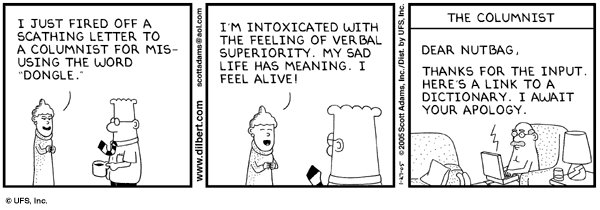
Update: This Dilbert strip sums up the situation pretty well (thanks to Mark Dowling for sending it to me). But whatever, I'm still right.

01 January 2005

putting the tyrants and the torturers on notice

[consider this a sketch of a real post. sort of meta-wit.]

People like Thomas Friedman are always saying that invading Iraq has put "the enemies of freedom" "on notice" (it's hard to write about this stuff w/o scare quotes), so that the undemocratic regimes elsewhere in the Middle East would be looking over the shoulder, wondering who's next, etc. Somehow this nervousness should cause them to be more accomodating towards the pro-democracy/theocracy reformers that so far we've only paid them to suppress.

A post I'd like to write would satirically take one of Bush's freedom on the march speeches and apply it to Morocco's recent and historic creation of a truth commission to investigate human rights abuses from 1956-1999 by the pro-Western King Hassan.

The idea is that Morocco is an example of how human rights advance in Muslim nations without bloody invasions and occupations from the West. This "puts on notice" the Crusader types who run Abu Ghraib while they're cutting deals with Qualcomm to install CDMA in Iraq instead of GSM. Combine it with lines like "justice will eventually come to those who run the torture chambers at Abu Ghraib" and Bush's line "All nations are in this struggle together. And all must fight the murderers" and the piece should write itself! Which is good, because at this rate I probably won't write it.

why I don't want to live in Westchester

From an article (interesting in its own right) about stay-at-home dads, titled "Housewives, try this for desperation":
Many stay-at-home fathers find that they are fish out of water, too.

"Conversations with men here [in Purchase, NY] revolve around banking, and the kinds of cars you drive, and the country club," Mr. Purinton said. "That gives me the heebie-jeebies. I'm socially ill at ease. I'd rather talk to the mothers about raising children."

Non-white racism (or Eurocentrism, part 2)

In House of Flying Daggers, a Chinese kung-fu movie, the heroine is much paler than the male leads. (Yes, I realize I use "kung-fu" with about as much precision as my grandfather uses the word "chop suey.") In old Miyazaki anime movies, the men look Japanese (if they're not animals), but the women are so light-skinned that I thought they were white at first. In Ray's The Lonely Wife, it's the same story with skin color, but in India.

How is this so universal? Is it because of contact with Western racism or because rich women who stayed indoors more were lighter skinned than men who worked outside?

Eurocentric every last one of 'em

FOX's tsunami coverage (which I watched w/o sound at a gym) spent several minutes with the story of a Czech supermodel who survived at a beach in Indonesia.

I didn't even know where to begin being upset. It's like the 7-layer burrito of Evil. Or the joke headline: "American tourist in India almost hit by falling body of man committing suicide."

Update: CNN did a feature on a different model, who I think dated a local boy. I know my blog should aim for wittiness and not inchoate rage, but these people are just such scum. It's so hard not to hate them.

Americans, not women.

Engraved on the World War II memorial in Washington D.C.:
Women who stepped up were measured as citizens of the nation, not as women.... This was a people's war and everyone was in it.

Colonel Oveta Culp Hobby

19 December 2004

love those republicans

on the importance of male-male relations:

Viacom's Gail McKinnon sent an e-mail this week to offices in the U.S. House of Representatives regarding a job opening in Viacom's government relations department. The e-mail calls for a male, Republican to fill the open position and reads as follows: "Importance: High We need to hire a junior lobbyist/PAC manager. Attached is a job description. Salary is $85-90K. Must be a male with Republican stripes."

but of course not that kind!

Bush is interested in Allen's opinions because Allen is an elected Republican representative in the Alabama state legislature. He is Bush's base. Last week, Bush's base introduced a bill that would ban the use of state funds to purchase any books or other materials that "promote homosexuality". Allen does not want taxpayers' money to support "positive depictions of homosexuality as an alternative lifestyle". That's why Tennessee Williams and Alice Walker have got to go.
On a side note, the whole "educated tolerant liberals vs. red-state neanderthals" narrative (c'mon! Tennessee Williams! Hamlet! These people are against Shakespeare.) makes me uncomfortable, even though in this case there does seem to be some truth to it.

dear reader(s)

To be honest, I have trouble thinking about this blog as me communicating to you, rather than me communicating to myself in a way where I don't mind others listening.

On that note, here is me writing about movies I've seen recently, so I won't forget what I thought about them a year from now.

  • About Baghdad - Great documentary made by this Iraqi-American who goes to Baghdad in June 2003 (the occupation's "honeymoon," though it might not have seemed so at the time) to ask Iraqis how they felt about the war, the end of Saddam, etc... He had wanted to go all over Iraq, but it wasn't safe to leave Baghdad. He said that today he wouldn't feel comfortable doing even that.

    I mostly liked it because it felt like a conversation among Iraqis, so it wasn't narrowly directed at the American political scene like Fahrenheit 9/11, and it didn't have Westerners constantly speaking for Iraqis, which gets annoying as shit after awhile (kind of like "would someone please remember the children?"). Also the director is more honest about his biases than e.g. Michael Moore in Fahrenheit 9/11, and gives plenty of air time to opinions that he clearly disagrees with. There's this awesome scene towards the end when he's arguing with a taxi driver: the director is saying that the U.S. is to blame for the Iran-Iraq war and for Saddam crushing the Shiite uprising in 1991, while the taxi driver says that Iraqis should take responsibility for their own leaders. Eventually the driver pulls over and turns off the meter in order to get more into the argument, which goes on for awhile.

  • outfoxed - Less good. Mostly stuff I had seen before and doesn't really address how much other TV news sucks, not to mention the NYT, NPR, etc... Random example: Maureen Dowd saying we need "positive profiling" (sorry, forgot to permalink) of air travellers, so that we stop wasting time on nonthreatening white grandmothers. Also, everything Thomas Friedman writes. There was a good excerpt of a Bill O'Reilly interview with an anti-war activist whose father died in the WTC. But it would've been better just to watch the interview w/o commentary.

    While I'm writing, I'll post some quality O'Reilly links that the gay-book-banning article in my last post vaguely reminded me of.

    I guess I'm trying to say that FOX is pretty well covered by the internet, without the need for movies to profit from us being pissed off. Speaking of the latter, I get annoyed at movies that little attempt to engage the mainstream because of the profit motive in preaching to the converted.
  • The Lonely Wife by Satyagit Ray. Losing blog patience, but awesome blend of personal and political. Plus I like to identify with out-of-touch theorists/idealists. I need to see more by this guy.
  • he loves me, he loves me not (a la folie, pas du tout!), starring Audrey Tautou. Medium good, but I think I'd rather watch Mulholland Drive a third time.
  • women on the verge of a nervous breakdown by Almodovar. Decent, but my hopes were so high after All about my mother and Talk to her that I was a little disappointed.
  • Watermelon Man by Melvin van Peebles and starring Jeff Gerber. Solid movie about 1970's-style racism. ("This neighborhood was getting a little Jewish, anyway.") Next up is Sweet Sweetback's Badassssssssss Song.
  • Castles Made of Namm - words fail.
  • reassemblage - a little too much like a lecture for my tastes. update!: My dad says that Trin T. Minh-ha (the director) made another movie, Naked Spaces, which is mostly the anthropological African breast footage that she mocksdeconstructs in this one. In fact, Reassemblage might even be confusingly-editted outtakes from Naked Spaces, but for some reason Naked Spaces gets much less attention. Strange...
  • Sideways was excellent, but American Splendor may have been even better.
Also, I want to save this quote from "The Body as Property" by Rosalind Pollack Petchesky in Conceiving the New World Order (1995):
[examples of why "consensual contracts" are not totally plausible:] "the trade of sterilization for jobs in Brazil or Norplant for nonimprisonment in the United States" (p. 396, citing The Alchemy of Race and Rights by Patricia Williams).

"The language of reproductive freedom is still burdened with 300 years of the dominant Euro-American model of dichotomization between self and community, body and society." (p. 404)

09 November 2004

in the spirit of ahren's comment

Here's my try at a consistent line of communication through history:

now

then

And even further back to the Declaration of Independence:

He is at this time transporting large Armies of foreign Mercenaries to compleat the works of death, desolation and tyranny, already begun with circumstances of Cruelty and perfidy scarcely paralleled in the most barbarous ages, and totally unworthy the Head of a civilized nation.