09 February 2006

Her voice is full of money

"She's got an indiscreet voice," I remarked. "It's full of---"

I hesitated.

"Her voice is full of money," he said suddenly.

That was it. I had never understood it before. It was full of money---that was the inexhaustible charm that rose and fell in it, the jingle of it, the cymbals' song of it... High up in a white palace the king's daughter, the golden girl...

From The Great Gatsby.

This same idea (substitutability of desire) can also be illustrated using more scientific language. The link is via Tyler Cowen, who also argues that in general, fiction and science have more in common than one would think.

Update: After reading that last paper, I can say that you get everything you need out of it from the abstract, or even just spending awhile thinking about the title and its implications. To me the overlap can be seen by looking at the questions: how do you argue that your claims are true, that they are interesting and/or that they generalize? In both cases a blend of precision and ambiguity is necessary, a specific insight together with a claim to reflect a larger truth, etc... The differences between a novel and a scientific paper then come from different definitions of truth, interestingness, and so on. We can see this by looking at how these concepts have changed over time: for example, many early English novels were meant to scare girls away from sex, so they were much more didactic and specific than, say, a Salman Rushdie novel. The "interest" of these novels is clearly related to their educational/social value; in some ways not so far from a modern social science paper, but with a more condescending relation between author and reader. Similarly the concepts of truth and universality change over time and across fields. But these are just the sort of things I was hoping were explored in Cowen's paper! I'm not actually going to go through them myself...

27 December 2005

Economics and the Public Purpose

Review of Economics and the Public Purpose by John Kenneth Galbraith

I realize that the title seems to suggest that reading the U.S. tax code would be more interesting, but Economics and the Public Purpose is actually a great book. The writing is wonderfully crisp and engaging, and the ideas are something that everyone needs to become familiar with, even if they sometimes overreach a bit.

Galbraith is a famous liberal economist, born in Canada in 1908 and somehow still alive. He wrote this book as part of a series which also includes The New Industrial State and The Affluent Society. I haven't read anything else by him, but if I do, I'll blog about it, and perhaps one of you can tell me about his other writings? Economics and the Public Purpose was written in 1970, and arguably the corporate climate has changed since then in ways that invalidate some of the book's arguments; however, I think most are still applicable.

As the title implies, the book is framed as a critique of economics (or as he calls it, "neoclassical economics") for not serving the public purpose. In particular, neoclassical economics assumes various things about markets that (a) are false and (b) obscure and thereby naturalize and strengthen existing power structures. These assumptions survive because of (b) and also because of their conceptual simplicity. Here are a few:

ideas from neoclassical economics
  1. Firms always try to maximize profits. (It might seem paradoxical that profits are zero in perfectly competitive markets, but this isn't a big problem either in theory or practice.)
  2. Sovereignty rests with consumers, whose tastes/needs dictate demand curves, and nature, which dictates supply curves. In particular, firms have no sovereignty, since if they try to do anything other than maximize profits they'll be replaced. (Even a firm in a monopoly position will be forced by its shareholders to maximize profits. Its shareholders have to, because they're mutual fund managers who will be fired if they don't. Or because if not, some aggressive new manager could borrow a few billion dollars, perform a hostile takeover and make higher profits. You get the idea...)
  3. Similarly for government. All government ultimately responds to voter will. Or maybe voter plus lobbyist will, and maybe voters are dumb, but still government officials have no meaningful agency of their own to exercise.
I've of course phrased these in ways where it should be obvious what's wrong with them.
problems with neoclassical economics
  1. Agency problems mean that corporations/governments are run in practice by managers (which Galbraith calls the 'technostructure') that are distinct from owners/voters. Monitoring is imperfect and costly.

    This idea has been enormously productive in economics, political economy and elsewhere. For example, perfect credit markets make persistent poverty hard to explain, since the higher marginal product of capital in India (or wherever) should cause American investors to prefer it to loser GM stock. This would mean that a country's starting amount of cash should dictate only its level of consumption, while production moves to wherever it's most efficient (assuming free trade). The problem is that prospective borrowers don't have collateral, and it's too hard to keep them from disappearing with the money they've borrowed. As a result, everyone invests (inefficiently) in rich countries and poor countries stay undeveloped. Microcredit seems like a good, if limited, answer to this problem.

    There are actually a lot of other interesting stories of agency problems, but I'll save them for another post, so I can focus on what Galbraith is talking about.

  2. Firms no longer try to maximize profits. Instead their first goal is growth, as long as profits are high enough to avoid bankruptcy or a takeover. This is because profits (mostly) go to owners, but the technostructure mostly benefits from growth, through promotions, increased market power and better job security. (Arguably corporate shakeups in the last few decades have weakened this argument, though much of it still rings true.) The only time profits become an issue are when there's the possibility of takeover, shareholder revolt, or some other kind of external threat, which is not too often if things are going decently.

    Some people have a hard time believing this point. If so, here's a useful thought experiment. Would you rather run a small dry cleaning business that gets 20% returns on capital, or be the CEO of GM in a year where the company loses 1% of its value?

  3. Firms no longer react passively to consumer demand, government regulation and market prices. Instead they can shape these with advertising, lobbying/regulatory capture and by using their market muscle to dictate prices. Advertising and lobbying are obvious. Regulatory capture is when the corporate technostructure links up with the government technostructure and helps shape government action; the most famous example is the military-industrial complex, but the same principle applies to the FCC, EPA, FDA, etc...: Congress can pass laws, but the implementation has to be left to bureaucrats who can never be perfectly monitored and held accountable. Finally, having a large market share (the result of a focus on growth) means that large corporations have a good deal of freedom to negotiate their own prices. However, while a neoclassical monopoly or oligopoly should charge higher prices (and have lower sales, but higher profits), we actually see lower prices (and higher sales) since firms use their market power to promote growth rather than profits.
So (neoclassical) economics gets it all wrong. So what? What's so bad about implicit rule by the technostructure? (I should point out that Galbraith often reads like Chomsky. He has the same sweeping and blistering critiques of ideology and orthodoxy, and is refreshing in many of the same ways. Both are good remedies to Thomas Friedman, for example. Of course, he's frustrating in some of the same ways too; sometimes he treats the reader as though we've never read anything other than the standard party line, c.f. Goldstein's book. One of their main differences is that Galbraith is a liberal and Chomsky is a radical, so that Galbraith proposes solutions that, though counter-cultural, are more technical than revolutionary.)
Why rule by technostructure is bad
  1. Inefficiency: Like in USSR-style state capitalism, prices and levels of production are set arbitrarily, and therefore inefficiently. If we presuppose that a free market will maximize total welfare (first law of welfare economics), then this is in general suboptimal. However, Galbraith gives more specific and interesting problems.
  2. Underdevelopment of the market sector: First I should explain that Galbraith refers to large corporations as the "planning sector," meaning that they can exert control over prices, consumer demand, gov. regulation, etc., as opposed to the "market sector," which consists of small firms that don't have this power. Many economic activities naturally fall within the market sector and resist organization into large corporations: personal services, local businesses, artists that can't deliver standardized products, etc..

    Since the planning sector is stronger than the market sector, they get to treat the market sector like a poor stepchild, for example passing price increases on to it as they see fit. Also, the market sector is vulnerable to inflation and interest rate fluctuations in ways that the planning sector is not, as large corporations are often able to finance expansion using profits rather than debt.

    So we have less art, medicine and child care than we should, though these arguments always seem a little dicey to me. More compelling is...

  3. Overdevelopment of the planning sector: We overconsume things produced by the planning sector, like cars and Coke.

    It seems like this can't totally explain problems like suburban sprawl, though. Is it the planning sector's fault that we have too many cars and too few trains? Well, sort of, in that one part of the planning sector (car manufacturers) muscled out another part (trolley manufacturers, or whatever). But it's not like some general tilt of the playing field away from the planning sector and towards the market sector would help this.

    More interesting is that we overconsume period. Or rather, we overconsume products and underconsume services and leisure (i.e. work too hard). This is relevant to the planning/market distinction because many services naturally fit into the market sector (because small/local businesses are involved), while manufactured products tend to come from the planning sector. Advertising is one mechanism that makes this possible. Advertising has many different effects: encouraging consumption of a particular brand (Saab), encouraging consumption of that class of products (cars) and encouraging consumption in general as a solution to problems (angst, need to express personality but not knowing how). (Or I could mention the rush credo for pre-frosh weekend: "rush MIT, then rush Greek, then rush AEPi," with "rush college" left implicit.) A car company without much market share can only take advantage of building brand awareness, while a large company also benefits from new drivers entering the market, since they'll get a decent fraction of them. Thus, we expect the planning sector to advertise more heavily than the market sector. Not only is this part of their advantage over the market sector, it also encourages consumption of products in general as a road to happiness.

    However, advertising is only the crudest way that the planning sector shapes public thought. Beyond telling us what to consume, it also tells us what to think.

  4. Shaping ideology: This last point is tricky, because large corporations of course don't have Thought Police (for the most part) and outside of their marketing departments, don't usually try too hard to shape public thought. However, ideology follows power, and so it's inevitable that our values will be shaped by the planning sector: the difference between serious/frivolous, respectable/eccentric, etc...

    One example is the different way that we view science/technology and art. Advanced technology is naturally suited to the planning sector, because it relies on standardization, mass production, specialized labor, and so on, while art is not, since it's usually better if it's individually produced. Before the Industrial Revolution, art and science were considered comparably valuable, and as science and engineering became more useful to people in power, social values changed accordingly. On the other hand, maybe people just respect money, and that's why executives have higher status than performance artists. But that can't fully explain why we think some jobs should be higher paid than others; it's considered natural for artists to be poor, and in fact there's often the suggestion that their art is better if they don't expect to be paid for it (i.e. they don't "sell out"). No one would ever suggest doing the same for scientists, even if most scientists are similarly motivated more by interesting work than by money.

The way that the planning sector shapes ideology is worth dwelling on, since it's the first obstacle to reform. Galbraith uses the term convenient social virtue to describe values of the planning sector that have been internalized by mainstream culture in ways that make things cheaper, easier or more profitable (hence convenient) for the planning sector. For example, the military needs to convince millions of people to enlist and get salaries much smaller than civilian contractors doing similar jobs. This can be done on the cheap by promoting the virtues of patriotism and serving one's country; equivalently, one might say that soldiers are compensated partly by their salary, partly by their social role, which lets them be proud of themselves and gives them respect from the rest of society. For example, Vietnam vets complain that they were cheated out of the post-war respect that they considered their due. And compare the reactions of soldiers and of corporate lawyers when the work they do is criticized: soldiers need the cultural compensation in a way that people with higher pay and better working conditions never would.

Patriotism also has the side benefit of helping the government convince the population to go along with its policies, especially wars. Iraq is a good example, but in general, the political system in the U.S. finds wars almost irresistible. Dwelling on this point turns the idea of government responding to voter preference (e.g. the median voter theorem) on its head, in the same way that Galbraith critiques consumer sovereignty. It's far from a new idea (recall the Goering quote: "Of course the people don't want war. But after all, it's the leaders of the country who determine the policy,..."), but it's interesting how Galbraith unifies his critiques of modern capitalism and of modern democracy. Similarly, the Nazi political theorist Carl Schmitt famously said that "Sovereign is he who decides on the exception"” (e.g. who declares a state of emergency).

There are many other examples of the convenient social virtue, and how it enables the system to be run more cheaply. Teachers, for example, could be underpaid initially because other jobs were closed to educated women, and later by representing teaching as a form of national service, as in Teach for America. Similarly for social work. (To see this, observe that if these jobs had competitive salaries, we wouldn't need to think of performing them as "service.")

Another of Galbraith's examples is the idea of the hard-working small business owner. He says that while those with comfortable jobs in the planning sector wouldn't accept unpredictable unpaid overtime, this is a natural part of the life of a small business owner. They put up with it because of the status afforded to entrepreneurs, rather than for the financial benefit. This one seems kind of dubious to me, mostly because I've forgotten his argument as to why it should help the planning sector, but also because even highly-paid people in the planning sector (like consultants) often work long hours, and because there are natural reasons for small businesses to be more flexible than large ones in many things, including demands on their workers.

Finally, he describes patriarchal consumerist family life ("the American way of life") as a convenient social virtue that's key to most of the others. The idea is that maintaining a high level of consumption requires women to stay at home to organize it all (an assertion which I don't think has aged well), but also that suburban family life encourages consumption through competitive pressure. It's seen as virtuous for women to take care of kids and do housework (w/o much pay) and for men to work hard to support their families. (An alternative choice might be for both parents to work part-time, reduce their consumption of goods and raise their consumption of services, including outsourcing housework. Or the traditional family might be rejected altogether.) Neoclassical economics overlooks all of these issues by making the "household" the unit of analysis rather than the individual.

The problem with this whole "convenient social virtue" discussion is that agency often gets confused, and it oversimplifies to say that the planning sector both benefits from and creates these convenient social virtues. The examples Galbraith gives are good starting points, but a Foucault-style critique is probably more appropriate. For example, The Wages of Whiteness is one long examination of how White supremacy became dominant in 19th century America; White pride is mainly considered a convenient social virtue for lower-class White workers (i.e. they receive social/psychological "wages" from their Whiteness), but the book goes on to say some nonobvious things about the origins of this racism. If/when I blog about it, I'll explain in more detail.

This post is getting long, so I'll skip to the punchline.

how to make things better
He starts with a section called "The Emancipation of Belief," which says that we need to actively resist advertising and propaganda that supports the values that come from the planning sector, instead of imagining that we're protected by cynicism about the more outrageous claims of advertising. Of course, this isn't really a personal project, and he's a little vague about how to pursue it with most of civil society in the hands of the planning sector, but it's a good start. And he also says that universities are a good place to organize around, since the economic necessity of critical thinking in universities will preclude any 1984-style repression.

The next step is to use the state (specifically the legislature) to restore economic parity between the planning and market sectors. This means easy credit from the central bank (since the planning sector finances expansion with cash and only the market sector needs credit), precisely targeted price and wage controls (since the planning sector is already controlling prices and wages), a universal living wage (he responds to the claim that it'll encourage unemployment by saying that unemployment is preferable to degrading low-wage work once you've rejected the convenient social virtue which says otherwise), and various other liberal reforms. In an era of New Democrats, New Labour (with new New Deals), etc., it's refreshing to hear such an unapologetic and compelling defense of big-government liberalism, even if it's not all completely convincing.

summary
Most of his arguments are still relevant in one form of another, and the writing is infinitely better and more enjoyable than the brief summary I've given above. Read it!

15 December 2005

Les causes des émeutes en France

For my evening French class I wrote a short piece about the riots in France. Since it's as interesting as anything else I post here, and since pretty much all my writing ends up either here or on the arxiv, I thought I'd share it. Plus, this way if I said anything stupid about France, someone here can correct me.

read French version of essay

Commençons avec les problèmes economique des immigrés et leurs descendants. C'est commun dans tout le monde que les immigrés arrivent pauvres, et soubirent la discrimination d'emploi et d'enseignement. En suite, c'est plus sur que leurs enfants manqueraient aussi de l'argent et de l'enseignement. Peut-être a cause des garanties d'emploi en France ce sera plus difficile de trouver l'emploi pour ceux qui ne sont pas déjà bien branchés. Et peut-être le fait que le systême d'enseignement français demande a une jeune âge des decisions importantes donne une avantage aux enfants avec des parents instruits? D'un autre coté, France a une système de protection sociale mieux que la plupart du reste de la monde. Mais peut-être ces programmes ne suffisent pas pour des communautés entières.

C'est improbable que tous les causes des émeutes sonts economiques. Le racisme est commun partout, mais en France elle est mélangée avec un nationalisme dangereux. Les vues racistes sur les français descendus des arabes ou des africains n'est pas qu'ils sont inférieurs, mais qu'ils ne sont pas vraiment francais. Ces vues sont associées avec la croyance du 19ème siècle qu'il y a une vraie identité française qui est culturelle et raciale, est qu'il faut la protéger des menaces étrangères. La forme la plus dégeulasse vient de la Front Nationale, dont les partisans disent que les immigrés (généralement non-Européens) constituent ce menace. Mais les formes de nationalisme defensifs plus bénins essaient aussi à protéger les fromages français contre les réglementations Européens, la culture populaire française contre l'Hollywood et la langue française contre l'empruntage des mots étrangères.

D'un autre coté, le nationalisme française essaie à éffacer les differences a l'intérieur de la France. Il n'y a pas de statistiques raciales, des lois contre la discrimination raciale, et surtout il n'y a pas une compréhension de l'identité comme quelque chose fondamentalement multiculturelle. Un exemple célèbre est la phrase ``nos ancêtres, les Gaulois,'' qui apparaissait dans les livres scholaires aussi tard que les années cinquantes dans la France et dans ses colonies. Malgré le fait que la plupart des français blancs ne sont pas descendus des Gaullois (leurs ancêtres etaient plutôt allemands), cette mythe culturel dit que les citoyens français avec des ancêtres africains (ou arabes, or portugais) ne sont pas vraiment français.

Cette contradiction en l'identité française est une raison que les émeutes sont si inquiétantes; elles sont un signe qu'il faudra laisser tomber les idées de la purété raciale et culturelle pour que on ait une société inclusive et democratique.

see my notes (in English) for the paper

for example, many immigrants arrive poor, face job + education disc. and pass on poverty and lack of education to their children. perhaps job security in france makes this worse for those without jobs? and perhaps the fact that the education system forces early decisions may also give an advantage to children with educated parents, and may make it harder to escape poverty, especially for culturally marginalized groups. on the other hand, france has better social programs than many countries; [remainder changed to ``but maybe these programs aren't enough to help entire communities.''] however, it is possible that they merely ameliorate the worst effects of poverty w/o helping people rise out of it. the problem of unemployment is not just a lack of income, it's also a lack of social integration.

codeterminted, but probably more significant is the problem of racism, here blended with french nationalism. racism directed against people of arab/african descent is not so much that they are inferior, but that they are not ``french.'' correspondingly, there is a strong notion of french identity that is reminscent of the 19th century ideas about racialized nationalism. on the one hand, we see frequently the idea that french culture, language, society and identity are under threat from the outside. the ugliest form of this is from the national front, who argue that immigrants constitute this sort of threat, and today call for their deportation. but milder forms of defensive nationalism also try to protect french cheese from EU regulations, french popular culture against Hollywood, french language against borrowing words from other languages.

on the other hand, french nationalism tries to erase differences within its borders. no statistics of race, no laws against discrimination, and most of all, no understanding of french identity as fundamentally multicultural. even in the 19th c, racial purity was a myth, and as late as the 1950's textbooks (in both france and her colonies) referred to ``our ancestors, the Gauls.'' (and even white French mostly have German ancestry - "nos ancêtres, les Gaullois" and general sentimentalizing of the Gauls were only invented ca. 1789 b/c they fit the politics of the time.) but these myths are the reason that french citizens whose ancestors are from africa (and not Gaul, poland, or portugal) are not considered french.

this refusal to acknowledge race is also why the riots are so troubling; they are a sign that ideas about racial/cultural purity will need to be dropped in order to establish a democratic and inclusive

Earlier I also prepared a talk for the class, which summarized a talk I had heard a year earlier about first & second-generation female Arab immigrants in France. Here are my semi-grammatical notes (in French), but you should really just google the prof I heard the original from to read more.

Pour mon discours, je vais resumer une conference que j'ai attendu l'année dernier. La conference s'appellé "des beurettes -- aux descendantes d'immigrantes nord-africains" et c'était donnée par Nacira Guenif-Souilamas, qui est une sociologiste a l'université de Paris.

Le mot "beurre" est verlan - on l'obtien par renverser les syllabes du mot "arabe" - et "beurette" veux dire une femme arabe. Déjá en regardant les mot, on peux voir que, quand on parle des jeunes arabes, souvent on s'occupe seulement avec les jeunes hommes arabes. On voix ca aussi avec la discussion sur les émeutes maintenant. Mais les jeune femmes francaise-arabe ont leurs propres perspectives, et leurs propres problemes.

La lecture que j'ai attendu était fondé sur des centaines d'entretiens que prof. souilamas a fait avec des jeunes femmes qui étaient nées en france avec des parentes nord-africains. Je vais concentrer sur seulement une de ses arguments, qui est que les voix dominantes en france disent qu'il faut proteger les femmes arabes contre la sexisme de la culture arabe et musulman. Souilamas a dit ensuite que cette position n'aide pas beaucoup les jeunes femmes arabes. Premierement, etre émancipé de la culture arabe est souvent quelque chose que elles ne veulent pas. Souvent elles choisissent les hijabs (head-scarves?) que leurs meres ont abandonné, ou elles sont plus conservative sexuellement; peut-etre comme facon de s'exprimer et revendiquer leur identité (well, to express themselves by asserting their culture..). Deuxiemement, l'injoction de devenir francais enseigne aux jeunes femmes que leur culture ne vaux pas beaucoup; donc quand elles écoutent cette message, elles parfois acceptent et intériorisent cette racisme. Au meme temps, ca ne le rends pas plus facile assimilation, parce-que il reste encore la discrimation. Troisiemement, la sexisme qui vient des hommes arabes n'est pas souvent la problem la plus pire qu'elles ont. Souvent les hommes faisent pire en école et ont plus de chomage, et puis n'ont pas beaucoup de pouvoir pour maitriser les femmes. L'état, au contraire, peux enlever des droits plus facilement, comme la loi recu qui a interdit les hijabs dans les écoles. On n'osera pas interdire des practiques d'hommes, mais pour "proteger" les femmes, on enleves leur autonomie.

Tout ca n'est pas pour dire que c'est toujour mieux pour les jeune femmes arabe en france de choisir la culture arabe au lieu de la culture occidentale. Mais, ca sera idéale si elles avaient une vrai choix, et si elles seraient respectées n'importe quel choix elles ont fait.

02 December 2005

Experimental validation!

Publications are all well and good, but you only really know that you've arrived in physics when you (and collaborators) propose some "arbitrarily accurate composite pulse scheme" and some respected experimentalists actually implement it! "Hot damn!" you say? And rightfully so, but let's see their conclusions.
The more complex B4 and P4 sequences, although theoretically superior, do not perform well in practice.
Oh well. It can be hard not to take this personally, and feel, after long days in front of the blackboard/web browser, that as a researcher and even a person, I am "in practice quite poor," "less useful than initially expected" and even "highly sensitive to the presence of off-resonance and phase errors." Happily, though, I'm still "theoretically superior"!

On the other hand, I did recently propose a "bubble-collapse" theory that explained the noise electric kettles made, and after some pointless arguing about rival theories, designed and carried out an experiment that proved I was right. (Stir it and the noise goes away!) Nevertheless, it's probably good that I've moved to CS.

Beware the Phase Errors, my son!
The sigma_X that bites, the sigma_Y's that catch!
Beware the Homogeneous Broadening, and shun
The Far-Off-Resonance Bandersnatch!

p.s. If you're on a job committee for one of my collaborators, I should point out that our sequences are just optimized for one kind of error, and of course by ignoring others the practical performance will be worse. Our paper should be thought of more as introducing new techniques/frameworks for producing composite pulses than as providing ready-made sequences that can be put into experiments. But please read it yourself if you're not sure.

01 December 2005

reading is fun! (damental)

Proof that if you make your slogan jarringly annoying enough, people will remember it decades later.

But seriously, reading is a good idea, and I should be doing more of it. Soon I'll try to blogs review of the (embarassingly short list of) books I've read this fall. But here's the quick summary.

  • Death of a Salesman by Arthur Miller. It's ridiculous how I haven't read or seen this before! This play is so moving that I wanted to clap after finishing Act One, even though I was just reading a script. And it's still incredibly relevant (if a little patriarchal): for example, you could argue that Requiem for a Dream just updated it for the 90's. And it's so much better than On the Road, which seems to be a lot more popular.

    The rest are in order of increasing specificity and convincingness.

  • Small is Beautiful: Economics as if people mattered by E.F. Schumacher. Classic 1970's critique of capitalism with a very Limits to Growth flavor. Argues that instead of prioritizing production through large-scale industry, we should focus on human fulfillment with smaller organizations. Nice ideas, but thoroughly missing is a look at the power relations that sustain the systems he criticizes. Without this, the whole thing starts to sound like those NYT editorials calling on the Bush administration to start respecting human rights. Plus the writing style often reminds me of management seminars and/or theology.
  • Economics and the Public Purpose by John Kenneth Galbraith. Classic 1970's defense of big-government liberalism. I would recommend it highly for the writing alone: crisp, witty, compelling and easy to read. I know the title makes it hard to argue this convincingly, but you really will enjoy reading this book. Anyway, I'll blog later about its contents in more detail, but for now will mention that its answers to the "why are things shitty?" question are much more specific and convincing than those in Small is Beautiful. It also proposes bold solutions that, while less convincing than the rest of the book (sometimes too radical, sometimes not radical enough, often dated), make a nice contrast with the usual alternative-less leftist whining.
  • The Wages of Whiteness by David Roediger. Explains how white working class racism emerged in 19th century America. Despite being much more academic and focussed than the above books, it's still very readable and engaging. I'll write later about how its specificity crushes Galbraith's arguments on the points where they clash. Also, almost all of its points are sadly still relevant today: how whiteness is constructed, why struggling separately against racial and economic oppression isn't likely to be successful, and how racism is so rarely about hatred. Again, the writing is inspiring; just check out the first few pages of the semi-autobiographical introduction (which you can do through amazon, or google book search) and you should be convinced to read the whole thing.
  • In the Shadow of "Just Wars": Violence, Politics, and Humanitarian Action. A collection of essays from Médecins sans Frontières staff, editted by Fabrice Weissman. Western political discourse usually misses the point so badly that it's offensive, especially when talking about poorer parts of the world. This book is an incredibly welcome counterpoint to that; but as it's late I'll keep this short. It discusses dozen humanitarian crises around the world, and critically reviews the responses to them. The results often aren't pretty, but I think we have a moral obligation to not to ignore them.
Wierdly, they all have a lot to do with money, though that wasn't my plan at the time.

Why have I read so little this year? I blame partly the thesis, but more the fact that I read too many blogs; for example, see this ironic blog post about how reading books is better.

11 November 2005

this time I really did learn from Wal-Mart

In response to a customer who wrote complaining that "Merry Christmas" had been replaced by "Happy Holidays" (via pandagon):
Walmart is a world wide organization and must remain conscious of this. The majority of the world still has different practices other than "christmas" which is an ancient tradition that has its roots in Siberian shamanism. The colors associated with "christmas" red and white are actually a representation of of the aminita mascera mushroom. Santa is also borrowed from the Caucuses, mistletoe from the Celts, yule log from the Goths, the time from the Visigoth and the tree from the worship of Baal. It is a wide wide world.
The Christians respond:
Catholic League president Bill Donohue speculated the writer of that e-mail was perhaps drunk.
Which is actually pretty fair; I would write that sort of email while drunk myself.

Update: The NYT weighs in and even they can't help but be funny. Also a grad student in the Bristol German department says that not all the credit for the xmas tree should go to Baal; 16-17c Germany played a vital role as well.

05 November 2005

perhaps I myself am not guiltless

From Walt Whitman's "Democratic Vistas," quoted in a great article about why American political novels generally are moralizing crap that can't compare with what Europeans like Orwell and Stendahl have written.
It is the fashion among dillettants and fops (perhaps I myself am not guiltless,) to decry the whole formulation of the active politics of America, as beyond redemption, and to be carefully kept away from. See you that you do not fall into this error. America, it may be, is doing very well upon the whole, notwithstanding these antics of the parties and their leaders, these half-brain'd nominees, the many ignorant ballots, and many elected failures and blatherers. It is the dillettants, and all who shirk their duty, who are not doing well. As for you, I advise you to enter more strongly yet into politics. I advise every young man to do so.

26 October 2005

Learning from conservatives

Sometimes they have a lot to teach us. Listen once in a while, and we might learn something. For example, here's Wal-Mart on the evils of Medicaid-dependency:
The memo said Wal-Mart workers tended to overuse emergency rooms and underuse prescriptions and doctor visits, perhaps from previous experience with Medicaid.
They go on to point out that health savings accounts are mostly useful for screening out people likely to get sick (also known as skimming). While this is pretty obvious, most people wouldn't realize that just making jobs more physically active is an even more cost-effective way of achieving this!
The memo proposed incorporating physical activity in all jobs and promoting health savings accounts. Such accounts are financed with pretax dollars and allow workers to divert their contributions into retirement savings if they are not all spent on health care. Health experts say these accounts will be more attractive to younger, healthier workers.
Also, sometimes people say that efficiency and health gains from causing people to change behavior will outweigh the negative effects of screening. "Not so!" says Wal-Mart, and one has to assume that they know their shit.
"It will be far easier to attract and retain a healthier work force than it will be to change behavior in an existing one," the memo said. "These moves would also dissuade unhealthy people from coming to work at Wal-Mart."

On a somewhat unrelated, and much less sarcastic, note, they might have some good points about the origins of the minimum wage and about the role of White Southern business owners in ending Jim Crow. (But lest we confuse conservatives with people with actually admirable politics, let's take a moment to remember Rosa Parks.)

Update: The full Wal-Mart memo is also educational. And encouraging! In the "Public Relations" section, it concludes that

While [Wal-Mart] critics have not yet harnessed all of these facts, they are successfully exploiting those they do have, suggesting that, when discovered, the others will also become effective ammunition.

23 October 2005

frogmarch! frogmarch! frogmarch!

It's been years since reading the news has been this enjoyable! Josh Marshall points out that we should still watch out for Administration damage control, specifically trying to get everything to stick to Libby, and letting Bush float above things the way Reagan did. More fundamentally, we shouldn't be fooled when the press starts saying that they've changed, and really do love democracy, and while they might mumble a lot over their apology for all that Iraq WMD reporting, everything's under new management and it's all going to be better now; despite this, let's not start trusting our abusers any time soon.

In any case, I think this is a good time to post some of my favorite links related to the scandal. (Drafted months ago, as with many of my recent posts...)

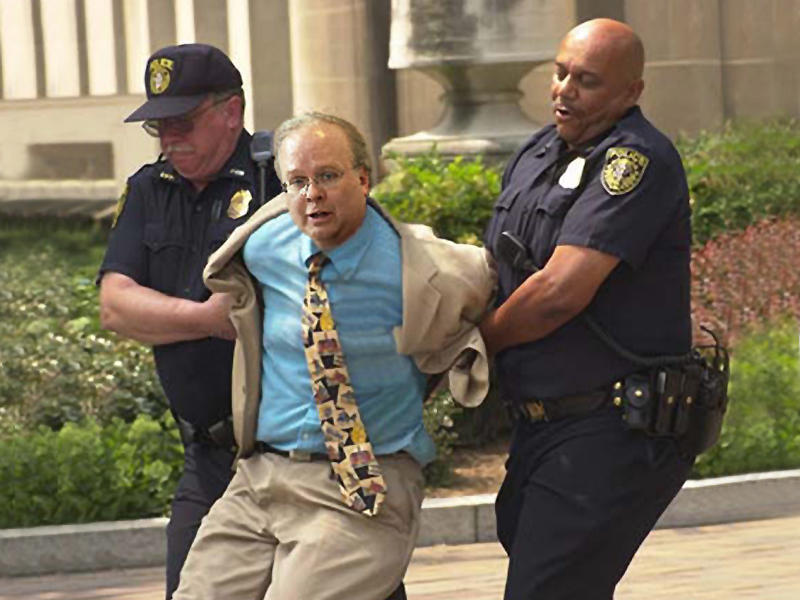
First, let's just take a moment to savor the word "frogmarch":

sadly, this was created using photoshop and is not a photo of actual events

Now, here's a video of the press trying to sweet-talk us into letting them back into our confidences. It's a beautiful sight, and if you haven't seen it before you should definitely watch, but don't let yourself be seduced.

Much less well-known is this gem from Josh Marshall about Robert Luskin, who is Rove's personal lawyer. You should just read the whole thing, but here's the key excerpt.

One case that jumps out at you is his representation of Stephen A. Saccoccia.

Saccoccia and his wife Donna were eventually convicted of laundering more than a hundred million dollars for various Colombian drug kingpins. Stephen is currently serving a 660 year sentence. Their racket was laundering drug money through companies which traded in precious metals.

Saccoccia was convicted in 1993. And Luskin [now Rove's lawyer] took up his case on appeal.

Eventually the Feds got the idea that the money Saccoccia had paid Luskin and his other attorneys for their services was itself part of the $137 million in drug money he was ordered to forfeit. Now, on the face of it this seems a bit unfair since under our system everyone is entitled to good representation and how was Luskin to know it was tainted money.

Well, the prosecutors thought he should have gotten some inkling when Saccoccia started paying Luskin's attorney's fees in gold bars.

Yep, you heard that right. Luskin got paid more than $500,000 of his attorney's fees in gold bars from his client who was trying to appeal his conviction on charges that he laundered drug money through precious metals dealers. Who woulda thought that was drug money?

Another key moment in this saga: the emergence of the line "double super secret background" on the national stage.

Mr. Cooper said he spoke to Mr. Rove on "deep background," saying the sourcing description of "double super secret background" he used in his e-mail message to his boss was "not a journalistic term of art" but a reference to the film "Animal House," where the Delta House fraternity was placed on "double secret probation."
Speaking of Rove, it's worth noting that he was fired by Bush Sr. for---you'll never guess---retaliating against an opponent by leaking a damaging story to Robert Novak! I have to admit, though, that I only learned about this via Mark Fiore.

Finally, in the recent Times coverage of the Miller fiasco, the google ads at the bottom were:

Cheap Flights - Iraq
Last minute deals and cheap flights to Iraq
www.travelbag.co.uk

Security Iraq
Convoy escorts, personal security, base security details
www.rr-group.co.uk

Jobs in the Gulf - US$79
Send your resume to 200 Consultants in the Gulf through Monster-Resumes
www.monster-resumes.com

Lest we forget what this First Amendment crap is ultimately all about.

The first ad has a link to "Saddam Airport" in Baghdad with airport code SDA. Unfortunately, there weren't any flights available, and the page that says this seems to think that SDA stands for Shenandoah. On the other hand, the second website seems well-maintained...

20 October 2005

one of several courses competing for the attention of a student

The only internet quiz I've ever posted (via Mick and Steve Flammia).

If I were a Springer-Verlag Graduate Text in Mathematics, I would be Bela Bollobas's Modern Graph Theory.

I am an in-depth account of graph theory, written with the student in mind; I reflect the current state of the subject and emphasize connections with other branches of pure mathematics. Recognizing that graph theory is one of several courses competing for the attention of a student, I contain extensive descriptive passages designed to convey the flavor of the subject and to arouse interest.

Which Springer GTM would you be? The Springer GTM Test


I think it is safe to say that this subsumes many other quizzes, like the nerdiness quiz.

18 October 2005

TB muddies the water

Since the patent for ciprofloxacin (a.k.a. Cipro) expires soon, Bayer is going to test the successor drug moxifloxacin against tuberculosis. If the clinical trials work, it'll be the first new TB drug in 40 years; something which should be high on the priority list of the human race, as 1.5-2 million die of TB each year (at one point, 1/4 of all preventable adult deaths in developing countries were from TB).

This potential new treatment is great news, but it's hard not to notice the fucked-up incentives that dictate availability of these drugs:

Beside the small profits made serving poor countries, there are other risks to registering a drug for TB. For example, the cheaper pills may be shipped back to rich countries for "gray market" sale. In nations with broken-down health systems, the drug may be sold openly and overused, leading to drug-resistant germs that make their way to rich countries and render the company's best-seller useless. And when millions use a drug for months, rare side effects can emerge, forcing its withdrawal, much like unexpected reports of heart attacks forced Merck to pull Vioxx, its best-selling painkiller, from the market.

"Companies are much more likely to offer drugs that have no commercial value, or to piggyback a drug from the veterinary sector and give it a human application," said Dr. Mary Moran, an expert on drugs for neglected diseases at the London School of Economics. "Big companies say 'TB muddies the water.' If it works, governments may try to restrict it for TB use. And if you get a side effect, you've just trashed your best commercial antibiotic."

The problem with drug-resistant diseases isn't even that eventually White people will get them, it's that their spread will undermine the value of crucial intellectual property.

Hopefully a future civilization will some day look back on the broader picture the way we look back at, say, child sacrifice. But at least this development is positive!

06 October 2005

coexisting with nature

This is less of a post than a placeholder for article links, but I saw an article that asked why mosquitos were essential to ecosystems; a natural question since this is one species most of us would like to see extinct. It turns out that mosquitos are actually more important than most other species to ecosystem survival, but only partly because they keep animal populations in check by spreading disease. Much more important is that they keep humans away by spreading disease. A pretty gruesome tradeoff, and hopefully one that is not often necessary.

With that prologue, here's an article about how the Northeast of the U.S. wasn't originally covered in forest, since Native Americans regularly used fire to clear land. The forests appeared as the Native Americans disappeared, which is why they're only a few hundred years old.

Also, an article titled Does a Tiger Lurk in the Middle of a Fearful Symmetry? points out that tigers and other wildlife have returned to the Korean DMZ. Landmines and barbed wire are far less of a threat than highways and subdivisions. Likewise, animals are doing much better with post-Chernobyl radiation than anywhere where there are people.

I feel weird ending a blog post without some kind of bold and ill-thought-out political statement, so perhaps I should say here that the U.S. should depopulate the middle of the country (other than farming, mining, parks, a few roads, trains and Wall Drug) and move everyone into dense cities with populations no smaller than half a million each. This is sort of happening already, but people are doing things to stop it that are shitty economically and worse environmentally.

Shooting Friedman in a barrel

Though this post was drafted almost a year ago, and neglected, Thomas Friedman is fortunately constant enough that it should stay relevant.

In this Thanksgiving 2005 article, he mocks privileged Americans whose unconscious selfishness ignores the sacrifices that our troops are making to establish democracy in Iraq. Examples are Republicans changing House ethics rules to save Tom Delay's bacon, overpaid basketball players and of course SUV drivers. The way he keeps coming back to Iraq needs to be quoted,

Yes, I want to be Latrell Sprewell. At a time when N.B.A. games are priced beyond the reach of most American families, when half the country can't afford health care, when some reservists in Iraq are separated from their families for a year, including this Thanksgiving, I want to be like Latrell. I want to make sure everyone knows that I'm looking out for my family - and no one else's.
in order to bring out the connection with
WALTER: Those rich fucks! This whole fucking thing-- I did not watch my buddies die face down in the muck so that this fucking strumpet--

DUDE: I don't see any connection to Vietnam, Walter.

WALTER: Well, there isn't a literal connection, Dude.

DUDE Walter, face it, there isn't any connection. It's your roll.

But what really makes this article over the top is that it's written by one of the leading American cultural figures most responsible for getting us into Iraq! If we're assigning blame to elites, Thomas Friedman gets way more of it than Latrell Sprewell. Adding further to the irony, of course, is that his article is all about how these elites enjoy their privilege entirely self-righteously, without any apparent guilt about our troops dying over there.

On a vaguely similar note, Naomi Klein has an article about how thoroughly blind Americans are to the fact that we're butchering Iraqis on a massive scale. In contrast, the Bristol Metro recently had the front three pages about war pornography on the normally "regular porn" website nowthatsfuckedup.com (no link to the Metro article, but see billmon for an explanation). The emphasis is still on how this is bad for the soul of the West, but at least violence against Iraqis is an implicit theme.

30 September 2005

newspeak

One gaping hole in the English language is that there's no universal word for females between the age of "girl" and "woman."

But that's only the most common example of how our uneasy relation with gender is wreaking havoc with an otherwise wonderfully expressive language. Consider the absurdity of saying "anchorman or anchorwoman," or my favorite, trying to pronounce a word I've seen often in print: "Latino/as."

The solution is actually quite simple, and manages to completely avoid the horrors of "womyn."

The answer isn't to stop using "man" to stand for all humans. It's to make "man" universal again! We can assume that when people used "man" more than 50 years ago, this is probably what they meant anyway, so translation shouldn't be a big deal.

Then we need to invent a single new word to describe male members of the species "man."

I propose "he-man," or simply "heman." It's more nearly symmetrical with "woman" and yet still manly (or should I say "he-manly"). Yes, there's an upfront cost of not being able to keep a straight face for the next few years. But future generations of hemen and women will thank us for protecting our language from the likes of chairwoman, firewoman and womanhunt.

(p.s. I drafted this over a year ago! But felt like too much of a dork to post it until I recently realized that I have more drafts right now than actual posts.)

29 September 2005

beyond Bisquick

Two pancake recipes, both tasty.

whole wheat pancakes

  • 2 cups whole wheat pastry flour (or whatever)
  • 1 tblspoon baking powder
  • 1 tsp salt
  • 1 tbl brown sugar or honey
  • 2 cups milk
  • 1/2 cup oil or melted butter
  • 3 egg yolks
  • 3 egg whites
Mix dry ingredients together and beat wet ingredients together, except the whites, which you should beat heavily, until peaks form. Then mix dry + wet thoroughly and finally fold the whites in. It's not really vital that you separate the egg whites, but it will make the pancakes fluffier if you do it right.

Of course you can (and should) also mix fruit into the batter. Blueberries/strawberries are obvious, but bananas will take things to the next level.

option two: who says you need to have the OJ on the side?

I actually haven't tried these, so let me know if you make them.
  • 2 eggs
  • 1/4c oil
  • 2c flour
  • 1/2tsp baking soda
  • 1/2tsp salt
  • 2c orange juice
Mix wet & dry ingredients separately, then combine.

16 September 2005

Lo vs. Wang becomes Lo vs Wang vs. arxiv.org

Every day, people post new papers on the arxiv.org preprint server, and they can update old papers. It's mostly unrefereed, but yesterday a paper titled "A brief history of the decoy-state method for practical quantum key distribution" (quant-ph/0509084) was replaced by the single line "This paper was removed by arXiv admin due to content not conforming to the standards of academic communication."

Fortunately (depending on your perspective perhaps), the arXiv still saves old versions of papers, and the original version is still online. Even non-quantum people should be able to appreciate the human drama contained within. (Quick summary: Lo is widely credited with being the first to do something, but Wang says that Lo's first implementation didn't work and/or didn't contain new ideas and that either he (Wang), or another guy, Hwang, was the first to do it, depending on how you define "it.")

I mention this a) because it's kind of funny when dirty laundry is aired in public, but b) because there are some semi-serious issues at stake. It's kind of tacky when people argue about priority, but let's be serious here - we do care about it, often we care about it a lot. And what exactly are "the standards of academic communication" when it comes to arguing about priority? And of course, who decides?

Right now, I think decorum may be preventing some useful clarifying discussion. For example, who should I cite for the result that N qubits can specify a reference frame to an accuracy of O(1/N^2)? quant-ph/0405082 and quant-ph/0405095 appeared on the same day. The acknowledgments in the published versions don't really clarify things. Do I cite both to avoid offending either group of authors? Or should I just cite quant-ph/0407053, which was definitely later, though also done independently? I might do this partly because I'm more familiar with its methods and partly because, being later, it references all the related papers, so that I only need one reference to explain this (for my purposes) rather tangential point. Frustratingly, it's hard to tell if a consensus emerges when people a) don't directly talk about it, and b) instead often err on the safe side by citing every paper that has made some contribution to the final answer.

Of course the problem is that people doing the citing (like me) care about things like not offending anyone, making the references useful to the uninitiated reader, and keeping the total number of references under control; usually in that order. The only people who care about clearly establishing priority are usually the authors of the papers in question, and of course they're always self-interested. This post is starting to have a pointless feel to it... But at least quant-ph/0509084v1 is a good read!

15 September 2005

travelling again

by Dar Williams

have i got everything?
am i ready to go?
is it going to be wild, is it gonna be the best time?
or am i just a-saying so-o-o-o?
am i ready to go?
what do i hear when i say i hear the call of the road?

i think it started with driving
more speed, more deals, more sky, more wheels
more things to leave behind
now it's all in a day for the modern mind

and i am traveling
again

calling this a ghost town
and where is the heartland?
and i'm afraid, oh, was there any good reason that i had to go
when all I know is i can never come back.

traveling i made a friend
he had a trouble in his head
and all he could say's that he knew that the bottle drank the woman from his bed
from his bed

he said "i'm not gonna lose that way again."

but sober is just like driving, more joy, more dread,
someone turns her head
and smiles and disappears
he's gotta take it like it is, and it goes too fast
and he is just like me, caught in-between, no sage advisor
does weary mean wiser?
and someday will i sing the mountains that carried me away away
from home and hometown boys like you?

yeah, but what about us?
was it really that bad?
oh it's hard to believe i want a highway roadstop
more than all the times we had,
on little dirt roads
what am i reaching for that's better than a hand to hold?

it really was about driving
not fame, not wealth, not driving away from myself
it's just myself drove away from me
and now i gotta get it back and it goes so fast,

so i am traveling
again

sitting at the all-nite,
picking up a pen
and I'm afraid, oh, was there any good reason that i had to go,
when all I know is I am all alone
again

and you are the ghost town,
and i am the heartland
and i can say, oh, that's a very good reason
that i had to go, but now all i know is i can never come back
and i will never go back.

13 September 2005

Meditation at Lagunitas

by Robert Haas

All the new thinking is about loss.
In this it resembles the old thinking.
The idea, for example, that each particular erases
the luminous clarity of a general idea. That the clown-
faced woodpecker probing the dead sculpted trunk
of that black birch is, by his presence,
some tragic falling off from a first world
of undivided light. Or the other notion that,
because there is in this world no one thing
to which the bramble of blackberry corresponds,
a word is elegy to what it signifies.
We talked about it late last night and in the voice
of my friend, there was a thin wire of grief, a tone
almost querulous. After a while I understood that,
talking this way, everything dissolves: justice,
pine, hair, woman, you and I. There was a woman
I made love to and I remembered how, holding
her small shoulders in my hands sometimes,
I felt a violent wonder at her presence
like a thirst for salt, for my childhood river
with its island willows, silly music from the pleasure boat,
muddy places where we caught the little orange-silver fish
called pumpkinseed. It hardly had to do with her.
Longing, we say, because desire is full
of endless distances. I must have been the same to her.
But I remember so much, the way her hands dismantled bread,
the thing her father said that hurt her, what
she dreamed. There are moments when the body is as numinous
as words, days that are the good flesh continuing.
Such tenderness, those afternoons and evenings,
saying blackberry, blackberry, blackberry.

12 September 2005

some black people who look like they might be preachers

If you haven't yet donated money for Katrina, these organizations may be better choices than e.g. the Salvation Army. At first, the clearly political framing of these groups made me uncomfortable, but I'm now pretty convinced that aid is necessarily and inevitably politicized already. Of course another problem is that they might not have the capacity to handle a lot of donations if this page gets too popular. Plus they're not so verifiable, etc...

Also, I wanted to save a quote from a NYT article titled "Gulf Coast Isn't the Only Thing Left in Tatters; Bush's Status With Blacks Takes Hit." (sadly no permalink)

One of Mr. Bush's prominent African-American supporters called the White House to say he was aghast at the images from the president's first trip to the region, on Sept. 2, when Mr. Bush stood next to Gov. Haley Barbour of Mississippi and Gov. Bob Riley of Alabama, both white Republicans, and praised them for a job well done. Mr. Bush did not go into the heart of New Orleans to meet with black victims.

"I said, 'Grab some black people who look like they might be preachers,' " said the supporter, who asked not to be named because he did not want to be identified as criticizing the White House.Three days later, on Mr. Bush's next trip to the region, the president appeared in Baton Rouge at the side of T. D. Jakes, the conservative African-American television evangelist and the founder of a 30,000-member megachurch in southwest Dallas.

It's good to see the president is finally taking charge of this dangerous PR crisis.

11 August 2005

Le Nature's Water

My substantial-cooler replacement at Bexley had a clash with a bottled water company that you can read about at: Le Nature's Water.

The funny thing (besides the posts that the VP of Le Nature's made on Jay's blog) is that googling for Le Nature's Water brings up Jay's site first. You can help perpetuate this by linking to Jay's site, preferably labeling the link "Le Nature's Water."


Speaking of corporations that could use a little more sunlight, Curves is opening a branch in central square (of Cambridge). I'll be sad not to be here to see the "For Sale" sign when it goes under! [Aug 11 update: The above link doesn't quite express my point about Curves starkly enough. A bitchphd guest blogger put it in stronger terms.]
Another Aug 11 update: I think it is important that everyone read this letter, even if they don't follow the above links to Le Nature's Water.

Cease and Desist Letter Received by my Web Host 8/3/05

Subject: Violation of Acceptable Use Policy

I am counsel representing Le-Nature's, Inc., and I am writing to inform you of violations of your "Acceptable Use Policy (AUP)" and "Terms of Service (TOS)" agreements by one of your customers. On July 2, 2005, a web log hosted by your service was posted at http://punkhop.com/jaysilver/index.php?p=41 that contained an article entitled "Ice Water, or Ass Water? Investigative Report." This article was credited to "jay," which refers to Mr. Jay Silver, the owner of at least two of your hosted sites, namely, www.jaysilver.net and www.punkhop.com. In this article, Mr. Silver violated several of your hosting policies, as well as various copyright and defamation laws. Mr. Silver compared the taste of Le-Nature's ICE WATER to "purified rotten ass" and "simmering armadillo feces." Mr. Silver further alleged that Le-Nature's product was made from "sewage treatment discharge." Such statements are defamatory and libelous. In addition to the above activities, Mr. Silver illustrated his article with copyrighted photographs which he copied illegally and without authorization from Le-Nature's website, www.le-natures.com. Such activities constitute a violation of the U.S. Copyright Act. Together, these activities are also clear violations of your AUP agreement, sections 1 (Illegal Use), 4 (Harassment), 12 (Copyright or trademark infringement), and 17 (Infringement of Copyright, Patent, Trademark, Trade Secret, or Intellectual Property Right).

...

As of July 13, 2005, Mr. Silver had apparently blocked my firm's access to his websites. However, when attempting to access his sites from computers outside of the firm, it appears that these websites are still readily accessible, and Mr. Silver has continued to add damaging comments to his web log. Therefore, we are requesting that pursuant to your policies, you terminate Mr. Silver's [edited for privacy] account and permanently remove this offending material. Please provide us with confirmation of these actions.

Sincerely,
[edited for privacy]
Pittsburgh, PA